Have you ever followed someone’s advice and wondered, “Why does this work for them, but not for me?”
Human Design offers a way to explore how you make decisions and why the same approach may not suit everyone. It starts with a chart calculated from your birth date, time and place.
But what do the shapes, lines and numbers in your chart actually mean?
This guide explains what Human Design is, what your chart shows and which parts to look at first.
What is Human Design?
Human Design is a system for exploring how you make decisions, approach opportunities and interact with other people. It uses your birth date, time and place to calculate a chart called a BodyGraph.
Each part of the chart has a meaning within the system. Some parts describe its suggested approach to decisions. Others cover themes such as learning, communication and relationships.
Unlike personality questionnaires such as Myers-Briggs (MBTI), Human Design uses your birth date, time and place to calculate your chart. There are no questions to answer, as it works from your birth details.
People use Human Design to ask more specific questions about themselves. For example:
- Why do I agree to things I later regret?
- What happens when I feel rushed to decide?
- Am I taking on something because I want to, or because I feel I should?
Your chart gives you suggestions to explore. You can compare them with what actually happens in your life.
Where does Human Design come from?
Human Design was introduced by Ra Uru Hu in 1987. It brings together elements of astrology, the I Ching, the chakra system and the Kabbalah into a chart.
Each contributes something different. Astrology provides the planetary positions used in the calculation. The I Ching contributes the 64 themes represented by the Gates. The chakra system and the Kabbalistic Tree of Life contribute to the framework of Centres and connections.
You do not need to study these traditions before exploring your chart. We’ll explain the main parts below.
Learn more about its origins at Jovian Archive.
What does your Human Design chart show?
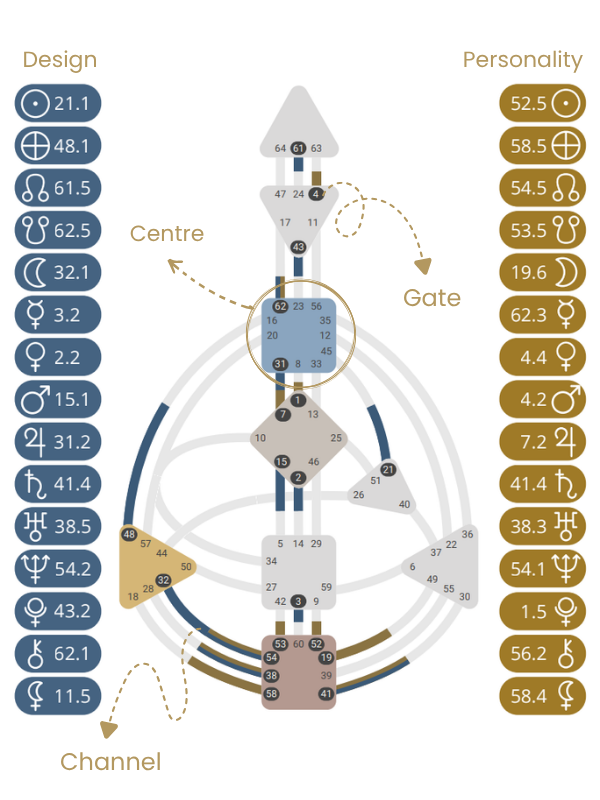
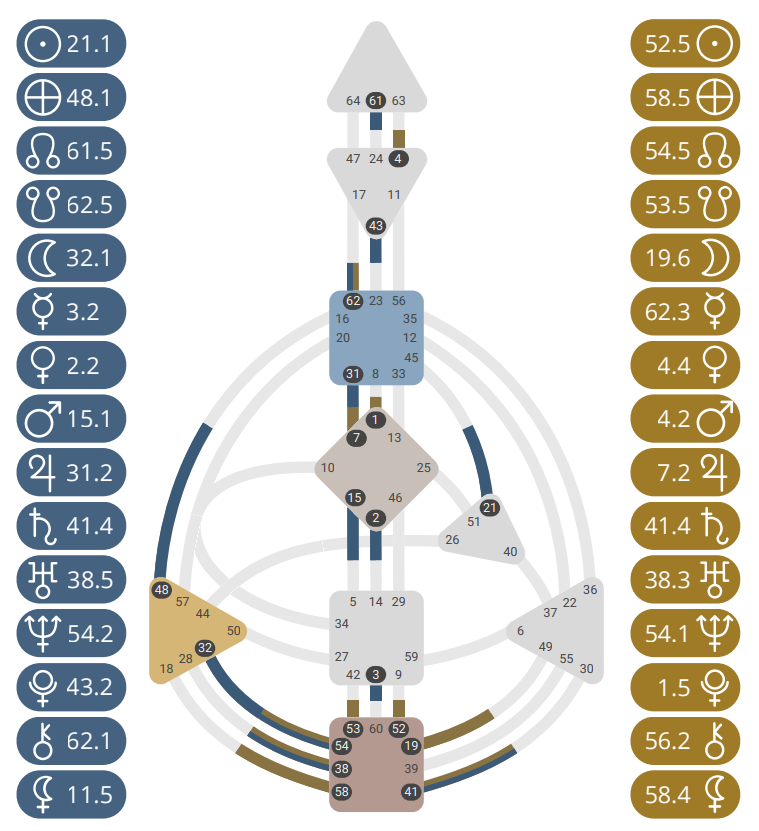
The body-shaped diagram is your BodyGraph. The shapes are called Centres, the numbered points are Gates, and the connections between Centres are Channels.
You don’t need to memorise them. Start with the results listed beside or below the diagram.
Type: Your Starting Point
Your Type is one of the first results you will see in your chart. It gives you a broad starting point for understanding yourself within Human Design. Each Type has its own Strategy for approaching opportunities.
The five commonly listed Types are Generator, Manifesting Generator, Manifestor, Projector and Reflector.
Strategy: How to Approach Opportunities
Should you make the first move, respond to an offer or wait to be invited? In Human Design, your Strategy offers guidance on how to approach opportunities. It is linked to your Type.
For example, a Generator’s Strategy is to respond to something they encounter. A friend asks, “Would you like to join this class?” That question gives them something specific to respond to.
A Projector’s Strategy is to wait for recognition and an invitation for significant opportunities, such as a job or relationship. Recognition means someone sees and values what they can contribute. For example, “You’re good at spotting what isn’t working. Would you help us improve this?”
Projectors don’t need an invitation for everyday activities, such as going for a walk, learning something new or working on a personal project. When an invitation does come, their Authority guides whether to accept it.
Authority: How to Make Decisions
How do you know whether something is right for you? In Human Design, your Authority describes the decision-making process suggested by your chart.
For example, Emotional Authority involves allowing time for clarity. Your feelings rise and fall in an emotional wave. An offer may seem appealing when you’re in a positive mood and less appealing when your mood drops, though the offer hasn’t changed. Giving yourself time helps you see beyond how you feel in a moment.
Sacral Authority involves noticing an immediate gut response to something specific, such as “Do you want to take on this project?” This may come as an “uh-huh” for yes or a “nuh-uh” for no.
Two people can share the same Type and have different Authorities. The different aspects of your chart work together, so reading them together gives you a fuller picture of what the guidance means for you.
The other parts of your chart
| Part | What it means |
|---|---|
| Profile | Two numbers, such as 5/1 or 2/4. They describe themes in how you learn, approach experiences and relate to others. |
| Definition | Whether your coloured Centres connect in one group or form separate groups. Reflectors have no defined Centres. |
| Centres | The nine shapes in your chart. Each represents a subject, such as communication, emotions or thinking. |
| Gates | The numbered points inside the Centres. Each represents a particular theme, such as creativity, listening or ambition. |
| Channels | The lines connecting Centres. When Gates at either end are activated, they form a Channel with its own meaning. |
Together, they explain why two people with the same Type can have different chart interpretations.
The shapes in your chart may be coloured or white:
- Coloured Centres are defined.
- White Centres are undefined.
- If a white Centre has no activated Gates, it is completely open.
In Human Design, coloured Centres show where your patterns tend to be more consistent. On the other hand, white Centres show where you may be more influenced by the people around you.
How do you get your Human Design chart?
You can generate your chart for free using three birth details:
- Date of birth
- Time of birth, as accurately as possible
- Place of birth, so the calculator can identify the correct time zone
Enter these into our free chart generator to see your chart and results.
What if you do not know your birth time?
You can still explore your chart with an approximate birth time. Enter the closest time you know. Some details may change if you find a more accurate time later. To check your time, try your birth certificate or baby book, ask a parent, or contact the hospital where you were born.
If you know roughly when you were born, comparing charts within that time range can show which details stay the same. Not sure how to check? Contact us and we can help you compare the results. If your birth time is completely unknown, you can still explore the system, but your personal results will remain uncertain.
How can you use Human Design in everyday life?
Knowing your Type is one thing. What do you actually do with that information when someone offers you a job or asks you to make plans? These three examples show how its guidance could apply to decisions you recognise, from accepting a job to making weekend plans.
You feel excited about an offer, then unsure later
You’re offered a new job. When you’re in a positive mood, it sounds like a great opportunity. When your mood drops, the same job seems less appealing, even though nothing about the offer has changed.
If you have Emotional Authority, Human Design describes these emotional highs and lows as an emotional wave. How you feel in the moment can affect how you see a decision.
Give yourself time to consider the offer in different moods. Do you still want the job once the excitement settles? Do the same concerns remain after your mood lifts?
There’s no fixed waiting period. You’re looking for a clearer sense of what you want over time, alongside practical details such as pay, responsibilities and working hours.
Everyone else wants to go, but your response is different
A friend asks, “Want to go hiking on Sunday?” Everyone else is going, but your immediate response is “nuh-uh”.
If you have Sacral Authority, Human Design suggests noticing that gut-feeling yes or no. It may come as an “uh-huh” for yes or a “nuh-uh” for no, before you have worked out the reasons.
You might then think, “I should go because everyone else is.”
Your gut response was no, but now you’re talking yourself into saying yes to fit in.
The advice that works for your friend may not suit you
A friend says, “Sleep on it. That always works for me.” But does waiting help everyone make a decision?
In Human Design, that depends on your Authority. Even two people with the same Type can have different decision-making guidance. For example, a Projector with Emotional Authority should allow time for their feelings to rise and fall, so their decision isn’t based only on a moment of excitement or doubt.
A Projector with Splenic Authority is guided by a quiet instinct, a little like a sixth sense. Something may feel right or off before they know why. The signal can be brief, easy to miss and may not repeat.
Knowing your Type is a starting point. Understanding your Authority alongside it helps you see how to apply that guidance to the decisions you face in everyday life.
Where Should You Start?
- Get your free chart. Use the most accurate birth details you have.
- Read about your Type, Strategy and Authority. Learn what they mean in your chart.
- Try one suggestion in everyday life. Notice how you respond and what happens afterwards.
- Explore the other details when you’re ready. Your Profile, Centres, Gates and Channels add more detail.
Have your chart but need help understanding it?
Seeing your results is one thing. Understanding what they mean and how they fit together can take more explanation. You might recognise yourself in a Type description but still wonder how your Authority, Profile and Centres change the picture, and what that means in everyday life.
Our personalised PDF reports explain different parts of your chart in clear, beginner-friendly language. See what’s included and preview example pages to help you choose a report.